
Case study
Changing thinking and investment in EV infrastructure

Research report powered multi-channel influence campaign

Local Authority investment saw significant shift toward on-street EV charging in following years
Over 100 Local Authority decision makers engaged directly with report launch
Objective
Back in 2020, Connected Kerb had just formed with a new proposition for on-street EV charging.
To open their market, we needed to shift local authority focus from town centre fast-charging towards on-street residential charging.

Approach
To shift the narrative, we conducted a survey on how EV drivers prefer to charge their cars, building evidence that people were more likely to buy an EV if they had overnight charging near their home.
This gave us a clear, data-backed message that residential and workplace charging was critical to increasing EV uptake for those without a driveway.
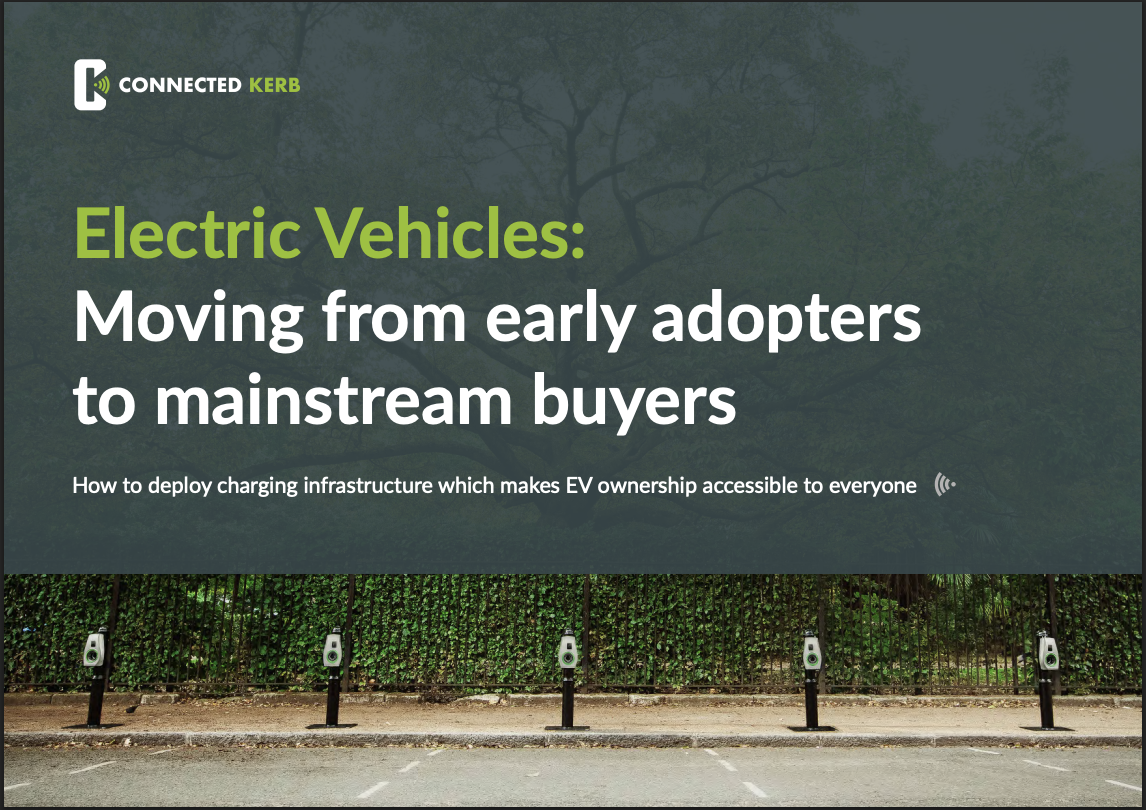
This data, alongside interviews with EV experts, was used to create the report Electric Vehicles: Moving from early adopters to mainstream buyers.
This report was then pushed to EV decision makers in local authorities via sales outreach, media, and webinars.
Results
The programme positioned Connected Kerb as an authority on EV infrastructure planning, using original research to shape how industry and policymakers understand the challenges of scaling charging networks.
The report and its insights generated extensive coverage in specialist media, including The Engineer, New Civil Engineer, Fleet World, Connected Car, Power Engineering International, Smart Energy, Current News, and Energy Live. This positioned Connected Kerb’s perspective on charging infrastructure directly in front of transport, energy, and infrastructure decision makers.
To engage those decision-makers more directly, the findings were shared through two industry webinars attended by more than 100 Local Authority representatives, alongside targeted outreach to existing prospects. Within the first month alone, 170 Local Authority stakeholders downloaded the report, while the outreach programme re-engaged hundreds of previously identified prospects.
The research also provided a foundation for long-term thought leadership, with insights atomised into a sustained stream of social media commentary and expert perspectives that reinforced Connected Kerb’s reputation as a trusted voice in EV infrastructure.
Crucially, the data and recommendations have become a core component of Connected Kerb’s commercial narrative, underpinning sales conversations and a growing number of speaking opportunities across the sector.
Since the report’s launch, EV infrastructure thinking has shifted significantly towards on-street charging. Our programme positioned Connected Kerb at the centre of that conversation as the company scaled rapidly to become one of the UK’s leading EV charging operators.

“We are looking for government and businesses to make high-value, long-term investments in our charging infrastructure. These decisions involve considerable thought. This project gave us an evidence-backed narrative which highlighted the need for our solution. The report itself – and the ideas and data within it – give us credible assets that will deliver long-term value across multiple sales and marketing channels.”
— Chris Pateman-Jones, CEO of Connected Kerb 

Why it matters
By grounding the conversation in real driver behaviour rather than assumptions about infrastructure, the programme helped shift how local authorities think about EV charging. Instead of prioritising fast chargers in city centres, decision-makers began to recognise the importance of reliable overnight charging near people’s homes.
This shift matters because the availability of convenient residential charging is one of the biggest barriers to mainstream EV adoption, particularly for drivers without access to a driveway. By demonstrating this through credible data and expert insight, Connected Kerb was able to influence both policy discussions and investment decisions.
The campaign not only opened commercial opportunities for Connected Kerb, but also helped accelerate a more practical and scalable approach to EV infrastructure — supporting the transition from early adopters to mass adoption of electric vehicles.